
The 20-20-20 rule for digital eye strain helps billions of people worldwide struggle with Digital Eye Strain, also known as Computer Vision Syndrome, caused by long hours of computer, phone and tablet use. According to the American Academy of Ophthalmology (AAO) and American Optometric Association (AOA), constant close‑range screen viewing keeps your eye’s ciliary muscle continuously contracted. Screen focus also lowers your natural blink rate, damaging the eye’s protective tear film. Common symptoms include eye dryness, soreness, eye fatigue, temporary blurred vision, and tension‑type headaches.
This globally‑recognized, doctor‑recommended gold standard eases screen‑related eye fatigue. Leading optometric authorities widely suggest the 20‑20‑20 rule for digital eye strain for anyone spending extended time in front of digital displays.
What Is the 20-20-20 rule for digital eye strain & Its Scientific Background
Core Definition of the 20‑20‑20 Rule: Every 20 minutes of screen time, shift your gaze toward a fixed object that is at least 20 feet (6 meters) away, and hold that distant focus for 20 seconds.
At roughly 20 feet, human eyes reach an optical‑infinity state. This fully relaxes over‑stretched ciliary muscles, restores natural blinking rhythm, and helps repair damaged tear film. This evidence‑based practice relieves accommodative spasm from heavy near‑work and reduces built‑up ocular pressure. Following the 20‑20‑20 rule for digital eye strain delivers quick relief after long screen sessions.
Real‑World Limitations of the Traditional 20-20-20 rule for digital eye strain
The 20‑20‑20 rule for digital eye strain delivers basic eye rest, yet it comes with notable practical limits. It only offers passive static relaxation for fatigued eyes. It can temporarily calm eye tension but cannot reverse degraded ciliary‑muscle elasticity or stiff extraocular muscles built up over long‑term screen exposure.
On top of that, most people struggle to remember and follow the 20‑20‑20 rule consistently amid busy work, study, or gaming sessions.
To create a complete, proactive eye‑care workflow and get more value from the 20‑20‑20 rule, targeted eye‑muscle training supplements make a meaningful difference. Our two wellness tools are designed to complement and upgrade basic 20‑20‑20 rest periods.
Upgrade Your 20‑20‑20 Breaks With Our Eye Training Tools
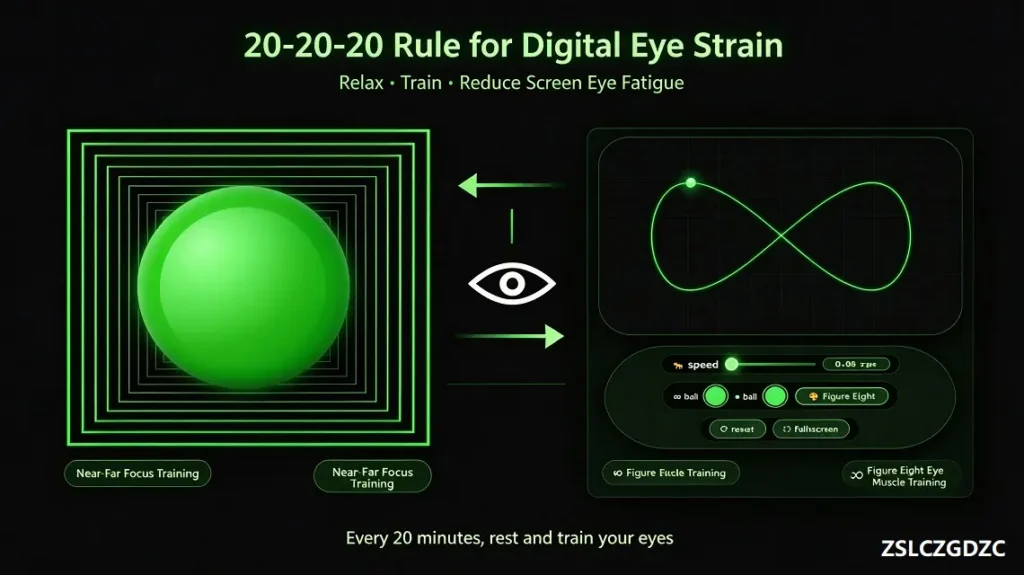
Near‑Far Ocular Accommodation Trainer
This tool aligns perfectly with the core concept behind the 20‑20‑20 rule. The classic 20‑20‑20 method only asks you to gaze far away for passive relaxation, which works as one‑sided relief. Our Near‑Far Ocular Accommodation Trainer replicates natural real‑world vision with repeated near‑far focus switching.
It delivers structured back‑and‑forth near‑and‑far focus training, actively working the ciliary muscle that grows stiff from endless screen time. It improves your overall ocular accommodation flexibility, helping your eyes switch smoothly between near and far objects. It helps guard against chronic muscle stiffness and accommodation lag caused by staying locked in near‑focus for hours.
Use this trainer during your standard 20‑20‑20 break windows. It transforms simple static distant‑gazing into intentional ciliary‑muscle conditioning, boosting the benefits you get from each 20‑second rest cycle of the 20‑20‑20 rule for digital eye strain.
Disclaimer: This is a wellness training aid, NOT a medical device. It supports everyday eye comfort and muscle flexibility. It does not treat eye diseases or correct vision disorders.
∞ Figure Eight Ocular Muscle Trainer
Once you have relaxed and activated your ciliary muscle via near‑far focus drills, working your extraocular muscles completes full‑spectrum eye relief. Staring fixedly at screens keeps your eyeball locked into one position. Over time this creates stiff extraocular muscles, weak binocular coordination, and poor local blood flow around the eyes.
The ∞ Figure Eight Ocular Muscle Trainer uses a smooth infinity‑shaped path to guide controlled horizontal and vertical eye‑tracking movements. It breaks the static screen‑gaze posture, stretches and engages all groups of extraocular muscles, improves eyeball mobility and binocular teamwork. It helps ease deep‑set eye soreness and congestion that simple distant gazing alone cannot resolve.
When used alongside the 20‑20‑20 rule for digital eye strain, these two tools build a complete eye‑care workflow: ciliary‑muscle relaxation and activation paired with extraocular‑muscle stretching and conditioning, addressing digital eye strain at the level of eye‑muscle function.
Your Complete Scientific Screen‑Time Eye‑Care Routine
- Observe the 20‑20‑20 rule every 20 minutes of screen use for baseline visual relaxation.
- Use the Near‑Far Ocular Accommodation Trainer in your break time to maintain ciliary‑muscle elasticity.
- Add sessions with the ∞ Figure Eight Ocular Muscle Trainer to stretch extraocular muscles and boost eye mobility.
- Practice full natural blinks and match screen brightness to surrounding ambient light for extra protection.
Important Wellness Statement: This content serves general eye‑wellness education only. Our products are non‑medical wellness aids and cannot replace professional ophthalmology exams, diagnosis or medical treatment. Seek timely care from a qualified eye‑care professional if you experience ongoing eye discomfort, persistent blurred vision, eye pain or other abnormal symptoms.