
Daily smartphone reading—scrolling articles, reading e-books, replying to messages, and browsing social media—has become unavoidable for modern people. However, prolonged phone reading is the leading cause of eye strain reading phone, a common type of digital eye strain affecting over 70% of frequent screen users. Unlike laptop or desktop screens, small phone displays force your eyes to maintain extreme close-range focus continuously, straining ocular muscles, reducing blink frequency, and triggering persistent eye soreness, dryness, and blurry vision. This article breaks down the scientific causes of small-screen eye strain and shares actionable habits plus professional eye training methods to relieve eye strain reading phone for long-term eye protection.
Table of Contents
What Causes Eye Strain Reading Phone On Small Mobile Screens
The core reason reading phones causes eye strain lies in the unnatural visual state small screens impose on your eyes, disrupting normal ocular muscle movement and circulation. According to the American Optometric Association (AOA), handheld mobile devices are the primary contributor to modern digital eye strain, with close-distance screen usage accounting for 80% of daily eye fatigue symptoms. (AOA)
Most people hold their phones only 8–10 inches from their faces, far closer than the recommended 12–18 inches for screen viewing. This sustained near-focus forces the eye’s ciliary muscle to stay tightly contracted for minutes or even hours without relaxation. Meanwhile, tiny phone text forces your ocular muscles to overwork to sharpen blurred letters, exacerbating muscle tension. A critical overlooked factor is reduced blink rate: phone reading cuts natural blink frequency from 15–20 times per minute to 5 times or less, leading to rapid tear evaporation, dry eyes, and burning discomfort. Anyone who spends hours scrolling will quickly notice signs of eye strain reading phone.
Over time, chronic ciliary muscle contraction causes accommodation spasm, resulting in slow focus switching—you may struggle to focus on distant objects immediately after phone reading, and develop persistent eye heaviness and fatigue. Many people ignore early warning signs of eye strain reading phone until discomfort becomes constant and disrupts daily life.
4 Common Symptoms of Phone Reading Eye Strain
- Sore & heavy eyes: Dull pain and swelling around the eye sockets after long phone reading
- Dry & gritty eyes: Insufficient tear lubrication caused by infrequent blinking
- Blurry near/far focus: Difficulty switching focus between phone screens and distant scenery
- Mild dizziness & fatigue: Ocular muscle tension triggering visual fatigue and mental tiredness
Science-Backed Safe Phone Reading Habits to Prevent Eye Strain
Most small-screen eye strain can be avoided with simple, standardized reading habits. These easy adjustments eliminate unnecessary ocular muscle pressure and reduce 60% of daily eye fatigue effectively, helping you avoid eye strain reading phone even during long mobile reading sessions.
- Enlarge font size: Adjust phone text size to a comfortable level that requires no squinting or extra eye effort to read clearly
- Maintain safe viewing distance: Keep your phone at least 12 inches (30cm) away from your face, and avoid leaning forward to stare at the screen
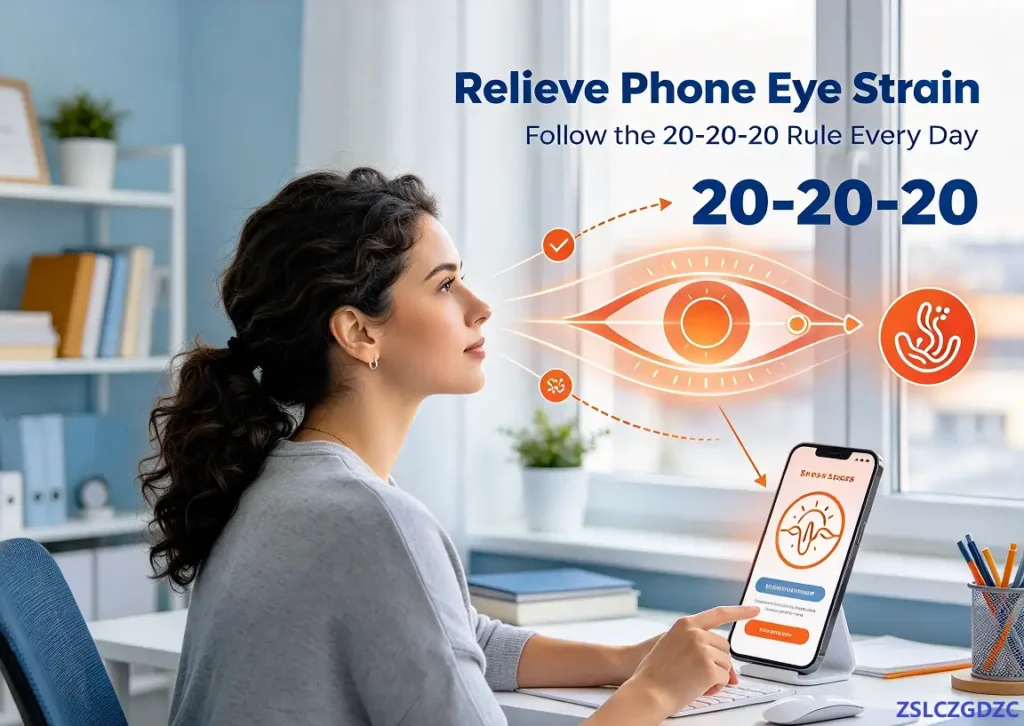
- Follow the 20-20-20 break rule: Every 20 minutes of reading, look at objects 20 feet away for 20 seconds to relax contracted ciliary muscles
- Avoid dark-room phone reading: Dim ambient light creates extreme screen brightness contrast, irritating eye retinas and worsening muscle strain
- Conscious blinking: Deliberately blink fully while reading to keep eyes lubricated and prevent dryness
Professional Eye Training to Relieve Post-Reading Muscle Tension
Daily habit adjustments prevent new strain, but they cannot release already tight, spasmed eye muscles caused by long-term phone reading. After intensive small-screen use, your ciliary muscles and extraocular gaze muscles remain locked in a contracted state, leading to cumulative fatigue. Targeted ocular training can effectively relax stiff muscles, restore eye accommodation flexibility, and speed up eye recovery from eye strain reading phone.
Near-Far Ocular Accommodation Trainer is a professional online training tool tailored for screen users’ ciliary muscle fatigue. Based on authoritative ophthalmic near-far vision theory, it uses a dynamic moving target to guide alternating near and far eye focus. This regular contraction and relaxation exercise effectively releases ciliary muscle spasm caused by long close-range phone reading, improves focus switching speed, and relieves eye heaviness and blurriness. With adjustable speed, customizable soft color schemes, and full-screen immersive mode, it delivers safe, non-irritating daily eye relaxation.
To comprehensively relieve full ocular muscle tension from small-screen reading, pair it with ∞ Figure Eight Ocular Muscle Trainer. This tool targets strained extraocular muscles, using a scientific infinite-loop eight-shaped trajectory to guide multi-directional eyeball movement. It boosts periorbital blood circulation, relieves fixed-gaze muscle stiffness from phone reading, and eliminates dry eyes and ocular soreness. Just 1–2 minutes per session, 2–3 times daily, delivers lasting eye comfort.
Key Benefits of Consistent Ocular Training for Phone Users
- Relaxes spasmed ciliary muscles and restores eye accommodation flexibility
- Activates extraocular muscles and improves eyeball mobility
- Promotes orbital blood circulation to reduce dry eyes and eye soreness
- Alleviates cumulative digital eye strain from long-term small-screen reading
Disclaimer
The online ocular muscle training tools are auxiliary daily eye relaxation solutions, not medical devices. They cannot replace professional ophthalmic examinations, medical diagnosis, or clinical treatment. If you experience persistent eye pain, blurred vision, dryness, or other abnormal symptoms after phone use, please stop self-training and consult a professional eye care institution promptly. Users with myopia, hyperopia, astigmatism and other refractive errors are recommended to wear fitted corrective glasses during training for better safety and effect.