
Looking for trusted family eye relaxation exercises? Millions of families across the United States live with persistent eye fatigue. Students doing homework on tablets, parents working remotely on laptops, and older adults scrolling phones all face the same issue: hours of near viewing keep eye muscles tight and under constant tension. These family eye relaxation exercises offer a gentle, science-backed way to ease that persistent tension. If you have searched for home eye exercises before, you may have noticed an important fact: evidence for many popular eye training programs is inconsistent. Not all eye drills deliver reliable relief, and no home visual exercise can correct refractive errors or cure eye disease.
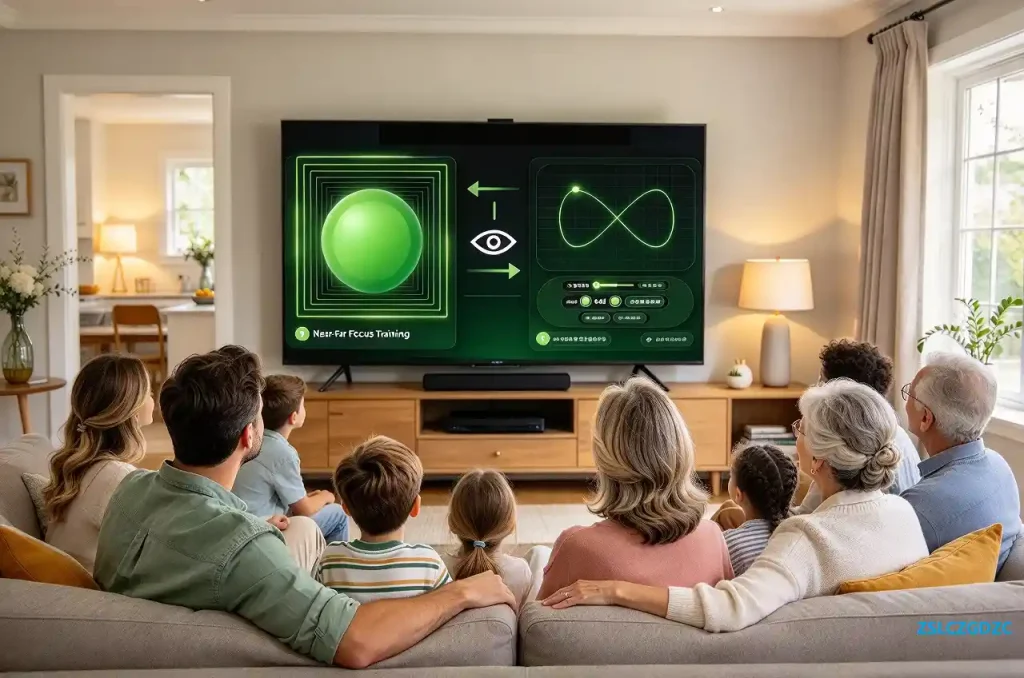
Table of Contents
The American Optometric Association (AOA) identifies prolonged near work as a major trigger for computer vision syndrome. Common symptoms include sore eyes, dryness, heavy eye sensation, and delayed focus switching between near and far targets. The American Academy of Ophthalmology (AAO) recommends simple behavioral habits such as the 20‑20‑20 rule: every 20 minutes, look at an object at least 20 feet away for 20 seconds to break sustained near-focus effort. Our two online visual training tools follow this same physiological principle and offer guided, repeatable routines for your family eye relaxation exercises. They are auxiliary training aids for healthy users with no diagnosed eye conditions and are not medical devices.
These two programs work together and target separate eye muscle groups to build your family eye relaxation routine:
- Near-Far Ocular Accommodation Trainer: focuses on the ciliary muscle and accommodation function
- ∞ Figure Eight Ocular Muscle Trainer: focuses on extraocular muscles and smooth visual tracking
1. Near-Far Accommodation Trainer | Family Eye Relaxation for Ciliary Muscle Relief
The Near-Far Ocular Accommodation Trainer is an independent browser-based visual training tool built on standard ophthalmic near-far vision principles. It is one of our core family eye relaxation exercises.
During long periods of close work, your ciliary muscle stays continuously contracted. Over time, sustained contraction may lead to accommodation spasm, eye soreness, dryness, and slow focus recovery. This tool uses a moving target that alternates between simulated near and far distances. Users follow the target with their eyes to cycle the ciliary muscle through contraction and relaxation. This routine supports the eye’s accommodation system, may boost local periocular blood flow, and helps release tight ciliary tension. Training can be done at home or during short rest breaks as part of your family eye relaxation exercises.
Core Features of This Near-Far Eye Relaxation Exercise
1. Near-Far Visual Target for Ocular Accommodation Training
Following the classic near-far accommodation model, the animated target cycles between near and far focal planes. Regular practice supports ciliary muscle flexibility and reduces fatigue caused by uninterrupted close work. Important distinction: the figure-eight trainer works extraocular tracking muscles, while this near-far trainer targets accommodation and the ciliary muscle. The two tools work together for complete eye relaxation in your family eye relaxation exercises.
2. Stepless Adjustable Motion Speed
A precision slider controls movement speed. Slow speeds deliver gentle relaxation for users with heavy fatigue; medium and faster settings build ciliary flexibility as you adapt.
3. Customizable Visual Interface
Three visual parameters can be adjusted independently: target color, background color, and trajectory line color. Soft contrast settings reduce harsh visual irritation and lower distractions during training.
4. Full-Screen Immersive Training Mode
One-click fullscreen hides browser popups and notifications for stable, uninterrupted visual tracking.
5. One-Click Parameter Reset
All speed and display settings reset instantly, convenient for multi-user family use and repeated sessions.
Standard User Guide
No ophthalmic training required. Sit upright, keep your head steady, and follow the moving target only with your eyes. Beginners and users with severe eye fatigue should start at slow speeds and progress gradually. We recommend 2–3 short sessions daily, 1–2 minutes each. Consistent gentle practice supports ciliary muscle relaxation when you use these family eye relaxation exercises.
Suitable Users
Office workers, students, people with prolonged close work experiencing soreness, dry eyes or slow focus recovery; healthy adults and children wanting routine ciliary muscle relaxation, with no diagnosed eye disease.
Safety & Important Statement
Stop training immediately and rest if you feel eye pain, dizziness, nausea or blurred vision. Never push through discomfort. This digital tool is for auxiliary daily relaxation only. It cannot replace professional eye exams, diagnosis or clinical treatment. If you wear prescription lenses for myopia, hyperopia or astigmatism, wear your correct prescription glasses while training. This is a fully digital online service; no physical product or shipment is provided. It cannot diagnose, treat or cure vision conditions. Visit a licensed optometrist or ophthalmologist for persistent eye discomfort.
2. ∞ Figure Eight Ocular Muscle Trainer | Family Eye Relaxation for Extraocular Muscles
The ∞ Figure Eight Ocular Muscle Trainer is the second of our family eye relaxation exercises, designed for people and families with frequent close visual work. It targets tension in the extraocular muscles caused by fixed near viewing. Guided smooth tracking encourages circulation around the eyes and eases routine eye fatigue.
Core Features of the Figure-Eight Eye Exercise
1. Science-Based ∞ Figure-Eight Trajectory Tracking
A target loops continuously along a horizontal figure-eight path. The movement guides your eyes through inward, outward, upward and downward tracking to fully engage extraocular muscles. This relieves stiffness from hours of static close gazing and supports smooth eye movement.
2. Full-Range Adaptive Speed Control
Speed adjusts from slow to fast via smooth slider control. Slow motion for gentle relaxation; faster speeds build tracking endurance as you adapt. Adjust according to your fatigue level.
3. Fully Customizable Visual Interface
Tweak trajectory color, target color and background color independently to avoid high-contrast strain and improve comfort.
4. Full-Screen Immersive Training Mode
One-click fullscreen removes browser distractions for stable visual tracking.
5. One-Click Parameter Reset
Quick reset for shared family use and repeated sessions.
Standard User Guide
Sit upright, hold your head still and track only with your eyes. New users begin slowly. Recommended routine: 2–3 sessions per day, 1–2 minutes each. Regular light practice reduces extraocular muscle tightness.
Suitable Users
Students, remote workers, and all healthy family members with soreness, dry eyes or stiff eye muscles from long near viewing, looking for simple daily visual movement training.
Safety & Important Statement
Pause immediately if you feel pain, dizziness, nausea or blurred vision. This is an auxiliary digital relaxation tool only and is not medical therapy. Prescription glasses should be worn during training if required. No physical goods are shipped. It will not diagnose eye disease, cure myopia or correct refractive errors. See an optometrist or ophthalmologist for ongoing eye problems.
How Families Combine These Two Eye Relaxation Exercises
For balanced daily eye care, many families rotate between the two exercises as their go-to family eye relaxation exercises:
- Near-Far Trainer: use when symptoms include slow refocus, blurriness after close work, or deep ache from accommodation strain
- Figure-Eight Trainer: use when eyes feel stiff, locked or tired from staring at a fixed near point
Both routines are short (1–2 minutes), safe for supervised children, and work perfectly inside rest breaks following the AOA 20‑20‑20 guidance.
Reference: AOA Computer Vision Syndrome Guidance | AAO Digital Eye Strain Advice
FAQ About Family Eye Relaxation Exercises
Are these family eye relaxation exercises proven to cure myopia or improve vision prescription?
No. These tools are daily relaxation aids for temporary eye fatigue and muscle tension. They cannot cure myopia, hyperopia, astigmatism, or permanently change your prescription.
Can children use these trainers?
Healthy children may use them with adult supervision for short sessions. If you notice vision concerns, schedule a formal eye exam with an optometrist.
Do I need special glasses to do these exercises?
If you have a refractive prescription, wear your properly fitted prescription glasses during training for comfort and clarity.
Is this a FDA-listed medical device?
No. Both programs are digital visual wellness tools for relaxation, not FDA-cleared medical devices. They do not replace professional eye care.
How often should my family practice?
2 to 3 brief sessions each day, 1–2 minutes per session, is the recommended routine. Do not over-train or push through discomfort.